

The Live Streaming Mafia
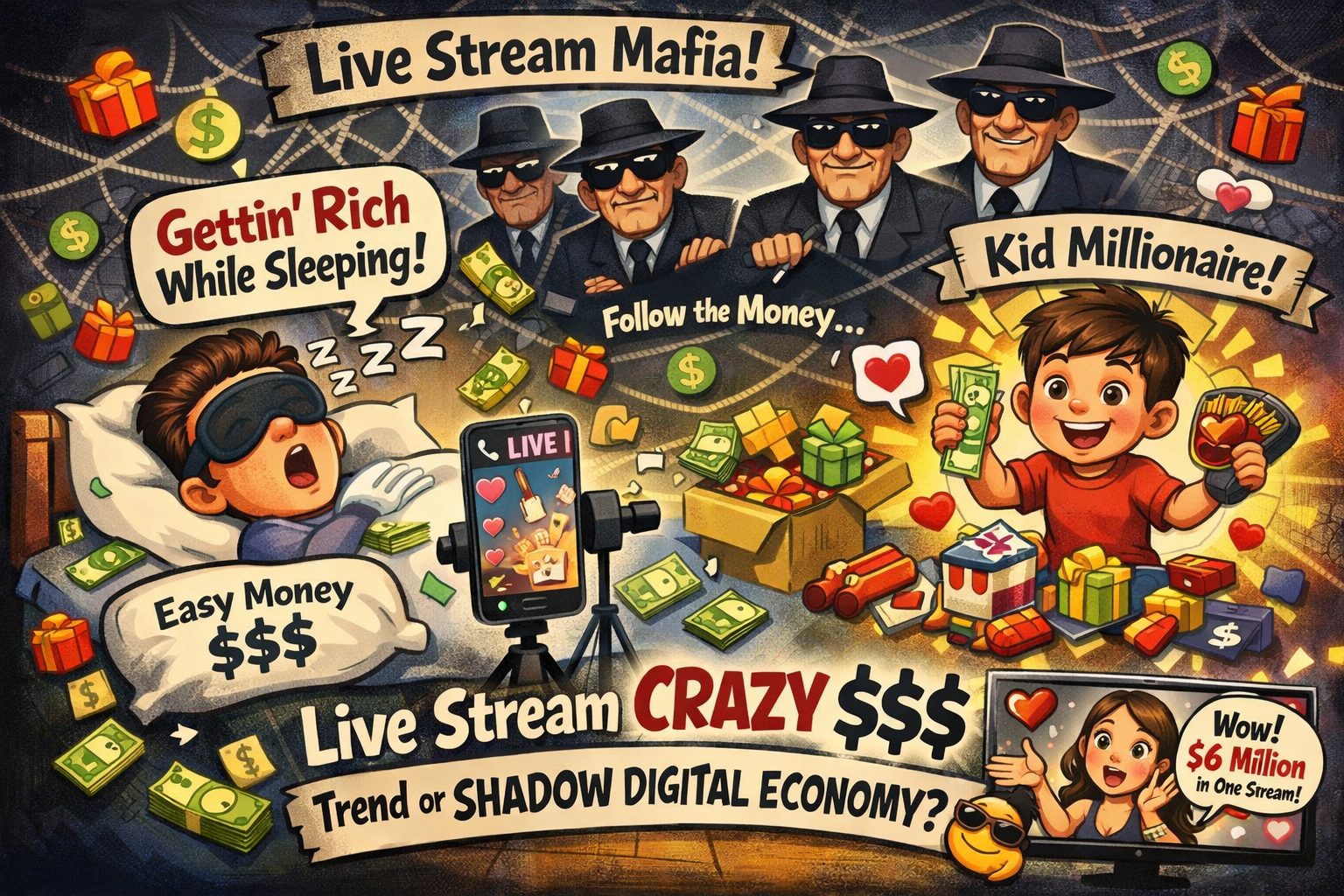
How Billions in Digital Gifts Move Around the World
By : Ali Khalil
In a world where money moves at the speed of light, the economy is no longer confined to banks and traditional markets. It has expanded into digital spaces that are sometimes difficult to fully regulate.
The live streaming economy is no longer but a powerful financial reality that demands a deeper understanding of what happens behind the screens.
While this sector creates real opportunities for profit and employment, the need for regulatory and legislative control remains essential to prevent these platforms from being exploited in ways that harm the economy or society.
In this context, Egypt’s regulatory and security institutions continue to play a crucial role in protecting the national economy through close monitoring and professional handling of emerging cyber and financial crimes—reflecting a significant advancement in tracking and surveillance capabilities.
The greatest challenge remains achieving a balance between encouraging the digital economy and preventing its illegal exploitation—a delicate equation that will shape the future.
In the end, smartphone screens may appear to be just a source of entertainment…
but the reality is that what happens behind them may be part of a complex global economy whose secrets have yet to be fully uncovered.
This is where the story begins… not where it ends.
— Ali Khalil
A True Story: From Live Streaming to a Million Dollars
A few years ago, the name Li Jiaqi was unknown outside the cosmetics store where he worked. He was an ordinary young man selling lipstick—until he decided to try live streaming.
In 2017, he began hosting live sessions reviewing and testing beauty products in front of viewers. Over time, he developed a unique style of engaging with audiences, testing hundreds of products and offering direct recommendations.
The result was astonishing.
In less than a year, his earnings exceeded $1.5 million, transforming him from a simple salesperson into one of the world’s top live-streaming stars.
As his popularity grew, so did his economic impact. In one session, he sold 15,000 lipsticks in just five minutes, and in another event, his live stream generated $1.7 billion in sales.
Chinese media dubbed him:
“The Lipstick King.”
His story is no longer just a personal success—it has become a global example of how the live streaming economy can turn ordinary individuals into millionaires in a short time.
Two Stories That Reveal the Shocking Side of the Industry
Story One: A Blogger Sleeps… and Earns Thousands
On TikTok, a content creator in Asia experimented with an unusual idea: live streaming while sleeping.
He simply went live from his room and did nothing but sleep. Surprisingly, thousands of viewers engaged with the stream, continuously sending digital gifts.
Within hours, the broadcast turned into a viral phenomenon, generating thousands of dollars in a single night.
This case sparked debate among digital economy experts, highlighting how platforms can generate income even from minimal or nearly nonexistent content.
Story Two: A Child Becomes a Multi-Million-Dollar Content Empire
In 2020, Ryan Kaji became one of the richest content creators in the world—before even turning ten.
His journey began with simple toy-review videos on YouTube. But the channel quickly exploded in popularity, attracting millions of daily views and major advertising deals.
Within a few years, his annual income reached tens of millions of dollars, making him a global digital economy icon.
The Shocking Number
$6 Million in a Single Live Stream
In one of the most astonishing cases, Chinese influencer Viya Huang generated over $6 million خلال بث مباشر واحد on Taobao Live.
Millions tuned in as she promoted products in an interactive format. Within hours, the combination of digital gifts and sales exceeded this staggering الرقم.
Experts see this as clear evidence that live streaming has evolved into a massive financial marketplace, sometimes rivaling traditional commerce in a single day.
What Do These Stories Reveal?
These examples show that digital platforms are no longer side activities—they have become a full-scale financial industry capable of creating enormous wealth in a short time.
But they also raise critical questions:
-
Who monitors the flow of money on these platforms?
-
How can legitimate earnings be distinguished from unknown sources?
-
Does the live streaming economy require stricter financial regulation?
The Shadow Digital Economy
Some experts describe this phenomenon as the Shadow Digital Economy—financial activities occurring online outside traditional banking systems.
Key characteristics include:
-
Small, repeated transactions
-
Cross-border financial flows
-
Difficulty tracing the origin of funds
These factors place the sector in a gray area that could be exploited in certain cases.
A Theoretical Money Laundering Scenario
-
Illicit funds are distributed across multiple accounts
-
These accounts send digital gifts to a specific streamer
-
The gifts are converted into platform earnings
-
The money is withdrawn as “legitimate income”
The Global Map of Live Streaming Economy
-
East Asia: China and South Korea dominate the industry, with agencies managing influencers
-
Eastern Europe: Reports تشير إلى استخدام المنصات في تحريك الأموال
-
Middle East: Rapid growth of creators using TikTok as a primary income source
Influencer Management Agencies
A new industry has emerged behind the scenes:
-
Training creators
-
Organizing competitions and challenges
-
Encouraging audience spending
These agencies take a share of profits, forming a structured digital ecosystem.
Market Size
-
Billions of dollars annually
-
Millions of creators worldwide
-
Rapid growth in Asia and the Middle East
Regulatory Challenges
-
Difficulty tracking financial sources
-
Lack of comprehensive regulation
-
Potential misuse of platforms
Proposed Solutions
-
Financial verification of creators
-
Monitoring large transactions
-
Taxation of digital earnings
Conclusion
The live streaming economy is no longer just entertainment—it is a powerful financial sector redefining income and work in the digital age.
As it continues to grow, one critical question remains:
Will money keep flowing freely behind smartphone screens… or will stricter regulation reshape this new digital economy?