

Gas Battle Ignites in the Eastern Mediterranean: Maritime Demarcation Fuels Power Struggle as Egypt and Libya Enter Diplomatic Confrontation
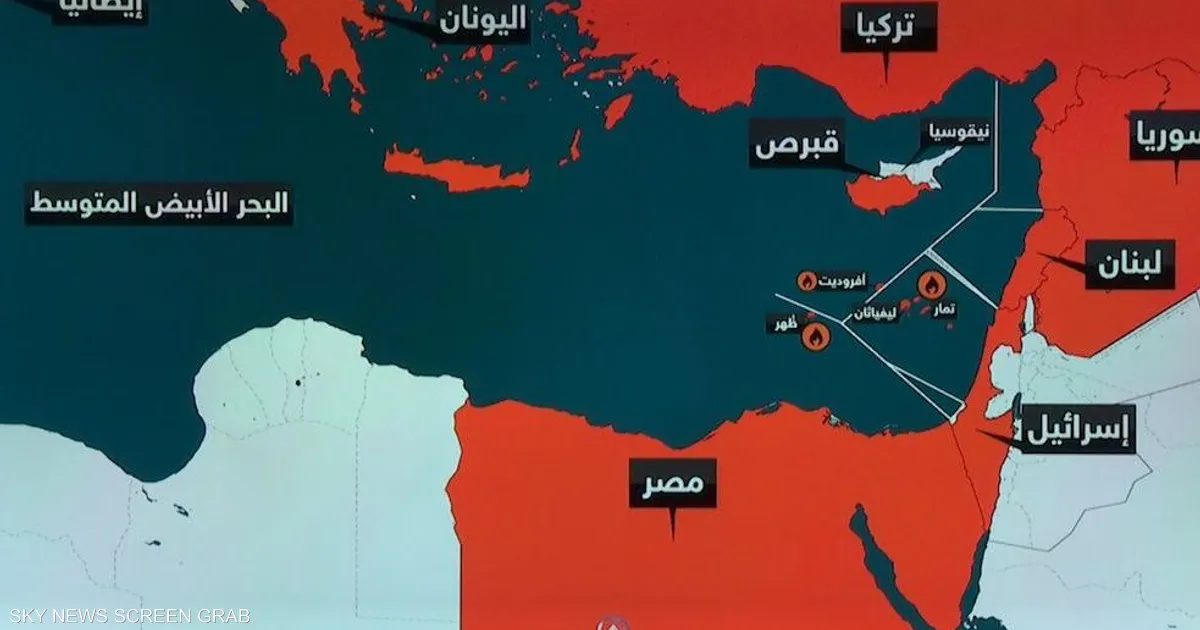
“Egypt-Libya Maritime Dispute Escalates AmidEastern Mediterranean Gas Race”
By Ali Khalil – Arab Telegraph | Special File
The gas file in the Eastern Mediterranean has moved far beyond an economic race over natural resources, transforming into an open political and legal battleground where sovereignty concerns, regional influence, and international alliances intersect. Recent moves related to the maritime boundary demarcation between Egypt and Libya have thrust the issue back into the spotlight, raising a central question:
Who will draw the future energy map of the region?
What is unfolding today in the Eastern Mediterranean is not a fleeting dispute over lines at sea, but a real test of the region’s ability to manage its wealth with statecraft rather than reactive politics. Recent history shows that conflicts beginning over gas rarely end there, and that the absence of early understanding often invites external interventions—at a cost borne by all parties.
From this perspective, the current demarcation battle should not be read merely as a clash of interests, but as a pivotal moment:
either the language of negotiation and international law prevails,
or the sea is left exposed to competing maps that reproduce cycles of crisis.
Arab Telegraph maintains that safeguarding rights cannot be separated from safeguarding stability, and that the real race is not who draws the line first, but who succeeds in transforming natural wealth into a source of strength rather than a spark for conflict.
What Comes Next? The Eastern Mediterranean at a Crossroads
The coming phase presents open scenarios ranging from containment to escalation. International interests—particularly European—may impose a negotiation track aimed at preventing a new regional confrontation. Alternatively, the dispute could be internationalized, turning the Eastern Mediterranean into a prolonged legal battleground. In the worst-case scenario, the gas file may become entangled with broader regional power struggles, making maritime borders fuel for wider crises.
Legal Perspective: Where Does International Law Stand?
Experts in the Law of the Sea argue that maritime boundary demarcation between adjacent or opposite states acquires binding international legitimacy only through a declared bilateral agreement or via United Nations mechanisms. The United Nations Convention on the Law of the Sea (UNCLOS) explicitly emphasizes consensus and negotiation when overlapping zones exist.
Specialists further stress that unilateral moves—regardless of legal maps or interpretations—remain vulnerable to diplomatic and legal challenges if rejected by the other party, opening the door to prolonged negotiations or deferred international disputes.
Energy analysts link the timing of Egypt’s move to global shifts in the gas market, particularly Europe’s efforts to reduce dependence on traditional energy sources, which has renewed focus on the Eastern Mediterranean as a promising energy hub.
They note that clearly defined maritime borders are a prerequisite for major energy companies, which are unwilling to invest in legally disputed zones—explaining the accelerated moves by several regional actors in recent months.
Key Takeaways
-
Egypt seeks to fortify its economic zones and secure gas investments—an internationally recognized right.
-
The Tripoli-based government is leveraging international legitimacy to counter unilateral actions.
-
Libya’s internal political divisions complicate the prospects for a comprehensive agreement.
-
The Eastern Mediterranean is entering a demarcation race no less critical than the race for exploration itself.
Recent Egyptian moves regarding maritime demarcation with Libya have triggered regional and international reactions amid an intensifying competition over Eastern Mediterranean gas resources. Cairo’s step comes within a broader diplomatic escalation following years of legal and political disputes over exploration and drilling zones in contested waters among Mediterranean coastal states.
Egyptian officials have emphasized that fixing maritime boundaries is essential to protecting the country’s economic and security interests, particularly safeguarding gas and oil zones located in Egypt’s western economic waters. According to media sources and international reports, the move represents a practical response to maritime agreements signed between Libya and Turkey in recent years, which Egypt considers an infringement on its maritime rights.
These developments unfold against a wider backdrop of competition for control over Eastern Mediterranean gas resources, as multiple actors contest maritime boundaries and exploration priorities. A similar maritime agreement signed between Turkey and Libya in 2019 remains a central point of contention with other regional states, including Egypt, Greece, and Cyprus.
Meanwhile, several Mediterranean countries—most notably Greece—have submitted legal memoranda to the United Nations concerning maritime demarcation with Libya, seeking to entrench their positions in accordance with international law and principles of negotiated settlement.
However, Libya’s Government of National Unity issued a strongly worded statement rejecting what it described as Egypt’s “unilateral maritime demarcation,” arguing that the move violates Libyan sovereignty and undermines its maritime rights. Tripoli called on Cairo to engage in bilateral negotiations or resort to United Nations mechanisms to resolve the dispute in a manner that preserves the interests of both sides under international law.