

When the Sands Speak… The Forgotten Africa
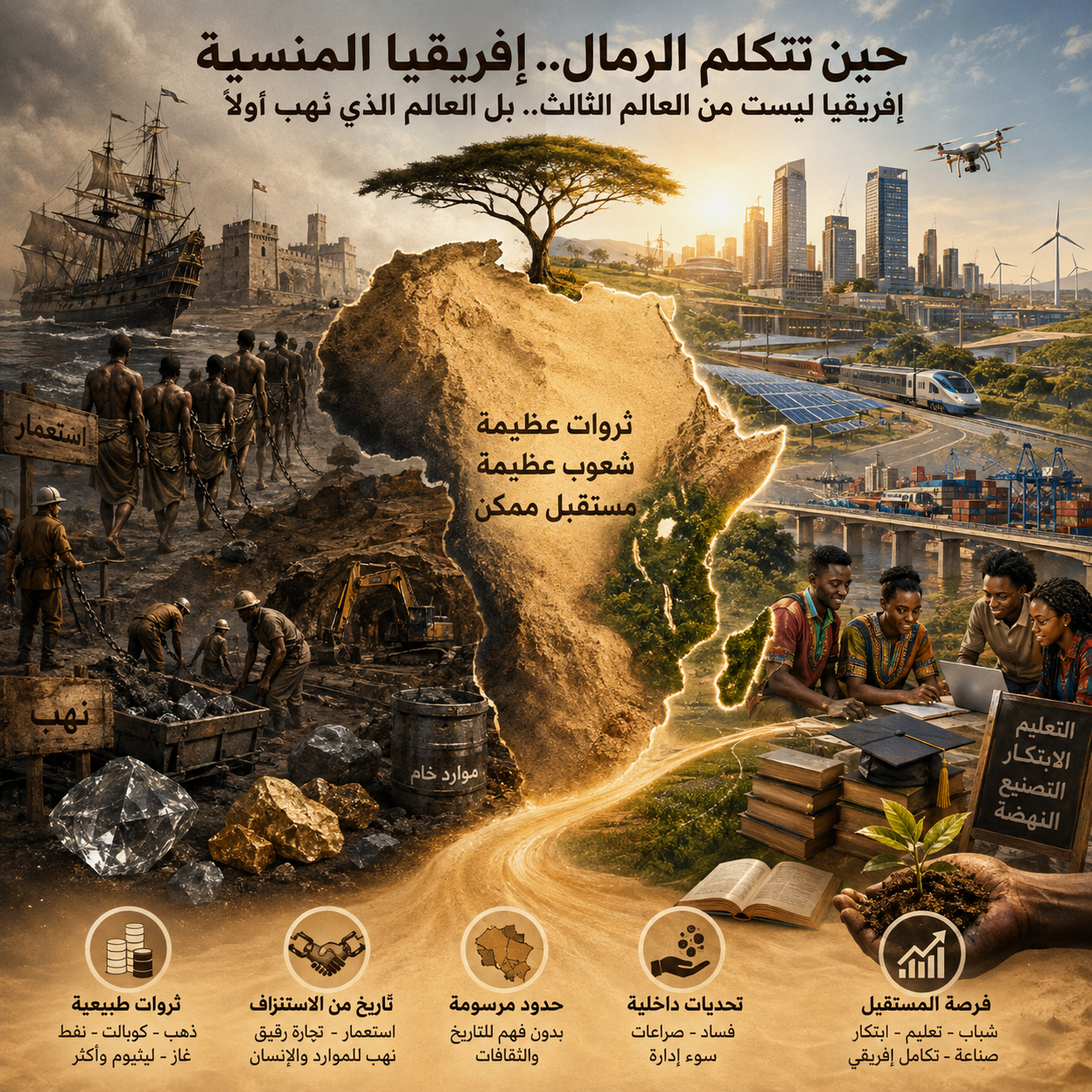
Africa Is Not the “Third World” — It Is the World That Was Plundered First

By: Dr. Maha Bastawy
For decades, one of the most misleading labels in modern history has been attached to Africa: the “Third World.” Repeated in textbooks, international reports, political discourse, and documentaries, the term gradually became embedded in the global consciousness as though it were a natural description of a continent defined by poverty, underdevelopment, conflict, and instability.
But there is a fundamental question that is rarely asked:
Was Africa poor in the first place?
Much of the world’s discussion about Africa begins with the outcome rather than the origins. We speak of famine before fertile land, poverty before natural wealth, and instability before examining the historical forces that helped produce it. The result has been a narrative in which Africa appears to have failed on its own, while the centuries of exploitation that shaped much of its modern reality are pushed into the background.
Look at the global map of natural resources and the contradiction becomes difficult to ignore.
Africa possesses enormous reserves of gold, diamonds, cobalt, oil, natural gas, uranium, copper, lithium, manganese, and many other strategic resources essential to the modern global economy. Some of the technologies that define the twenty-first century depend heavily on minerals extracted from African soil.
Yet the continent continues to be portrayed primarily as a symbol of poverty.
How can a continent so rich in resources remain home to some of the world’s poorest communities?
The answer may lie in a distinction that is often overlooked:
There is a difference between possessing wealth and controlling its value.
Before European colonial expansion, Africa was not an empty continent waiting to be discovered. It was home to powerful kingdoms, sophisticated societies, vast empires, and extensive commercial networks connecting regions across the continent with the Mediterranean, the Islamic world, and beyond.
Timbuktu emerged as a major center of scholarship and learning. The Mali Empire became one of the wealthiest political powers of its era. Across the Sahara, trading routes carried gold, salt, textiles, goods, knowledge, and ideas between distant societies.
But history is often remembered through the voices of those who ultimately controlled the narrative.
As a result, the names of European monarchs became familiar to generations around the world, while the rulers, scholars, merchants, and civilizations of Africa were pushed toward the margins of global history.
Then came the transatlantic slave trade, one of the most devastating chapters in Africa’s history.
Its consequences cannot be measured simply by counting the millions of people who were forcibly transported from their homelands. Every person taken represented a farmer, craftsman, trader, parent, soldier, scholar, or potential leader.
The loss was therefore not only human.
It was economic.
It was social.
It was demographic.
And it was ultimately a loss of future potential.
While European economies and ports benefited from the enormous wealth generated through the slave trade and related commercial systems, many African societies were left weakened by generations of human depletion and political disruption.
Then came direct colonial rule.
Africa was transformed into a vast source of raw materials for external economies. The objective was rarely to build diversified local industries capable of transforming African resources into finished products. Instead, economic infrastructure was frequently designed around extraction and export.
Railways and roads often connected mines to ports rather than cities to one another.
The logic was simple:
Extract the wealth. Move it outward. Leave the value-added production elsewhere.
Colonial borders created another enduring legacy. Political boundaries were frequently drawn according to external interests, with limited consideration for existing ethnic, cultural, linguistic, and historical realities.
When independence arrived, many African states inherited borders, institutions, economic structures, and political tensions that had been shaped under colonial rule.
The flags changed.
But many of the economic relationships did not.
This is one of the keys to understanding modern Africa.
A country may possess enormous mineral reserves and still capture only a small fraction of the wealth those minerals ultimately generate.
Take cobalt.
It is an essential component in many modern battery technologies, and Africa—particularly the Democratic Republic of the Congo—plays a major role in its global supply. Yet the greatest economic value is often generated elsewhere, where raw materials are transformed into batteries, electronic products, industrial technologies, and finished goods.
The lesson is larger than cobalt.
The greatest value is often created not where a resource is extracted, but where it is processed, transformed, patented, manufactured, marketed, and integrated into global supply chains.
This is how a country can be rich in resources while remaining poor in economic outcomes.
But an honest analysis cannot blame everything on external forces.
Africa has also experienced serious internal failures.
Corruption, authoritarian rule, military coups, civil wars, political instability, weak institutions, and competition over state resources have prevented many countries from converting their natural advantages into sustainable development.
Some political elites have squandered opportunities that could have transformed their societies.
Acknowledging this does not erase the history of exploitation.
Nor does acknowledging colonialism absolve African leaders of responsibility.
The truth lies in understanding both.
Blaming Africa entirely for its present condition ignores history.
Blaming the outside world for every contemporary failure ignores agency.
A serious analysis must do neither.
Perhaps even more powerful than economic exploitation has been the image created about Africa.
When Africa appears in international news, it is frequently associated with war, famine, disease, poverty, coups, and humanitarian disasters.
The world sees the crisis.
It rarely sees the university.
It sees the refugee camp.
It rarely sees the technology startup.
It sees the drought.
It rarely sees the millions of hectares of potentially productive agricultural land.
It sees instability.
It rarely sees the young generation building businesses, studying science, developing technology, and demanding a different future.
A partial picture, repeated often enough, eventually becomes a complete picture in the public imagination.
And that produces something even more dangerous than economic dependence:
psychological dependence.
When a society begins to believe that it is naturally poor, permanently backward, or incapable of competing with others, development becomes harder regardless of how many resources lie beneath its soil.
True development requires factories, universities, infrastructure, technology, and investment.
But it also requires something less visible:
confidence in the ability to build a different future.
That is why the question should no longer be:
Why is Africa poor?
The more important question is:
Why has Africa’s enormous wealth not yet been transformed into broad-based prosperity?
The difference is profound.
The first question assumes failure.
The second searches for the mechanisms that prevent potential from becoming prosperity.
Perhaps it is time, therefore, to retire the expression “Third World” when discussing Africa.
The continent is far too complex, too historically significant, and too strategically important to be reduced to a label created during a completely different geopolitical era.
Africa is not simply a story of failure.
Nor is it merely a story of conspiracy.
It is the story of a continent that endured centuries of exploitation, suffered internal failures, lost enormous human and material potential, yet still possesses extraordinary resources, a young population, strategic geography, expanding markets, and the capacity to become one of the world’s major centers of economic and geopolitical power.
The future of Africa may ultimately depend on one fundamental transformation:
moving from exporting resources to creating value.
From extraction to manufacturing.
From dependency to partnership.
From fragmented markets to integrated economies.
From consuming technology to developing it.
From being a source of wealth for others to becoming a controller of its own wealth.
Perhaps then the sands of Africa will tell a different story.
Not the story of a backward continent.
Not the story of a continent destined for poverty.
But the story of a continent that was rich long before the world discovered its riches—and that is finally beginning to reclaim the right to decide what those riches should mean for its people.
Africa is not a poor continent.
It is a wealthy continent whose people have too often remained poor while others controlled the value of its wealth.
And when the sands finally speak, they may tell the world something it should have understood long ago:
Africa was not born poor.
Africa was exploited before it was given a fair chance to become what it could be.