

UN Submission Invites States to Review How Religious Minorities are Assessed
By:Ali Khalil
A written statement to the United Nations Human Rights Council encourages decisions about
faith communities to rest on verifiable evidence.
London, 20 July 2026 — Two international human rights organisations have submitted a joint written
statement to the United Nations Human Rights Council.
The submission was made by United for Human Rights and the Coordination of Associations and
Individuals for Freedom of Conscience (CAP-LC), an organisation holding special consultative status
with the UN Economic and Social Council. It was filed to the 62nd session of the Council on 25 May
and circulated on 10 June under document number A/HRC/62/NGO/236.
The statement invites public authorities to draw on established facts when reaching decisions that
affect religious communities. It also encourages states to consider the criteria they use when
assessing minority faith groups.
A question with wider significance
CAP-LC presents the matter as one that reaches beyond any single community. The organisation asks
how a religious minority might best be assessed, and suggests that objective evidence offers a
helpful starting point.
The statement notes that information circulating internationally can inform administrative decisions
in other countries. In the United Kingdom, CAP-LC refers to the outcome of an application to register
Shincheonji as a charity, alongside the use of the word “cult” in public discussion. In Germany and
other German-speaking countries, the organisation says some members have described difficulties
in their professional and social lives.
For CAP-LC, these examples illustrate why the sourcing of information matters. The organisation
suggests that careful assessment helps communities to take part fully in public life.
The proceedings in South Korea
The submission refers to legal proceedings involving Lee Man-hee, the 95-year-old chairman of the
church. He was detained on 24 June in connection with alleged violations of the Political Parties Act,
and was indicted on 29 June. Investigators allege that between July 2021 and January 2024 he
directed the registration of around 50,000 church members with a particular political party.
The Church has responded that individual members took part in political activity of their own accord
and has cooperated throughout the investigation, including with searches and seizures, and has
expressed regret at the detention of a man of 95.
CAP-LC does not take a position on the merits of the case. The organisation restates two long-
standing principles. Every person facing prosecution benefits from the presumption of innocence.
Any deprivation of liberty is expected to meet the tests of necessity and proportionality.
The statement also notes that the International Covenant on Civil and Political Rights recognises the
right of every citizen to take part in political life.
Discussion within the academic community
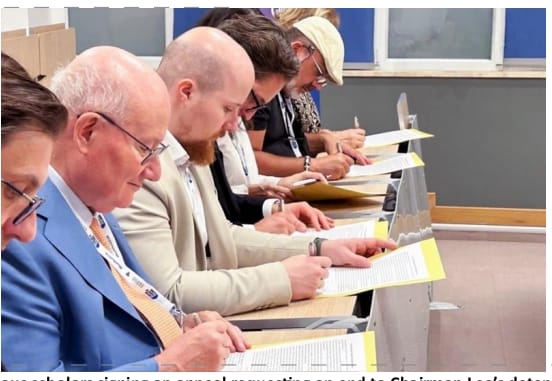
igious scholars signing an appeal requesting an end to Chairman Lee’s detention.
Related themes wer discussed at the Ninth Annual Conference of the European Academy of
Religion, held in Rome on 3 July. A session titled “Shincheonji, a Korean New Religion in Global
Context” brought together scholars presenting academic papers on the church.
Dr Massimo Introvigne, founder and managing director of the Center for Studies on New Religions,
observed that legislation across European Union countries generally treats the imprisonment of
people over 80 as exceptional. He referred to the United Nations Mandela Rules, which set out that
pre-trial detention is not intended to be the norm.
Eric Roux, president of the European Interreligious Forum for Religious Freedom, spoke about
human dignity, and suggested that the circumstances would benefit from review.
Alessandro Amicarelli, a solicitor of the Senior Courts of England and Wales and chairman of the
European Federation for Freedom of Belief, described South Korea as a country he has long regarded
as a firm democracy in which human rights are upheld.
An invitation to reflect
CAP-LC closes by encouraging states, courts and international institutions to consider how religious
minorities are assessed, and to ensure that decisions rest on evidence that can be verified.
Freedom of religion, equality before the law and the right to a fair trial are described in the
statement as foundations of democratic society. The organisation offers the case as an opportunity
for reflection, in a spirit of welcome towards communities of every belief.