

Between Reality and Screens: The Test of Egyptian Media in Times of Regional Upheaval
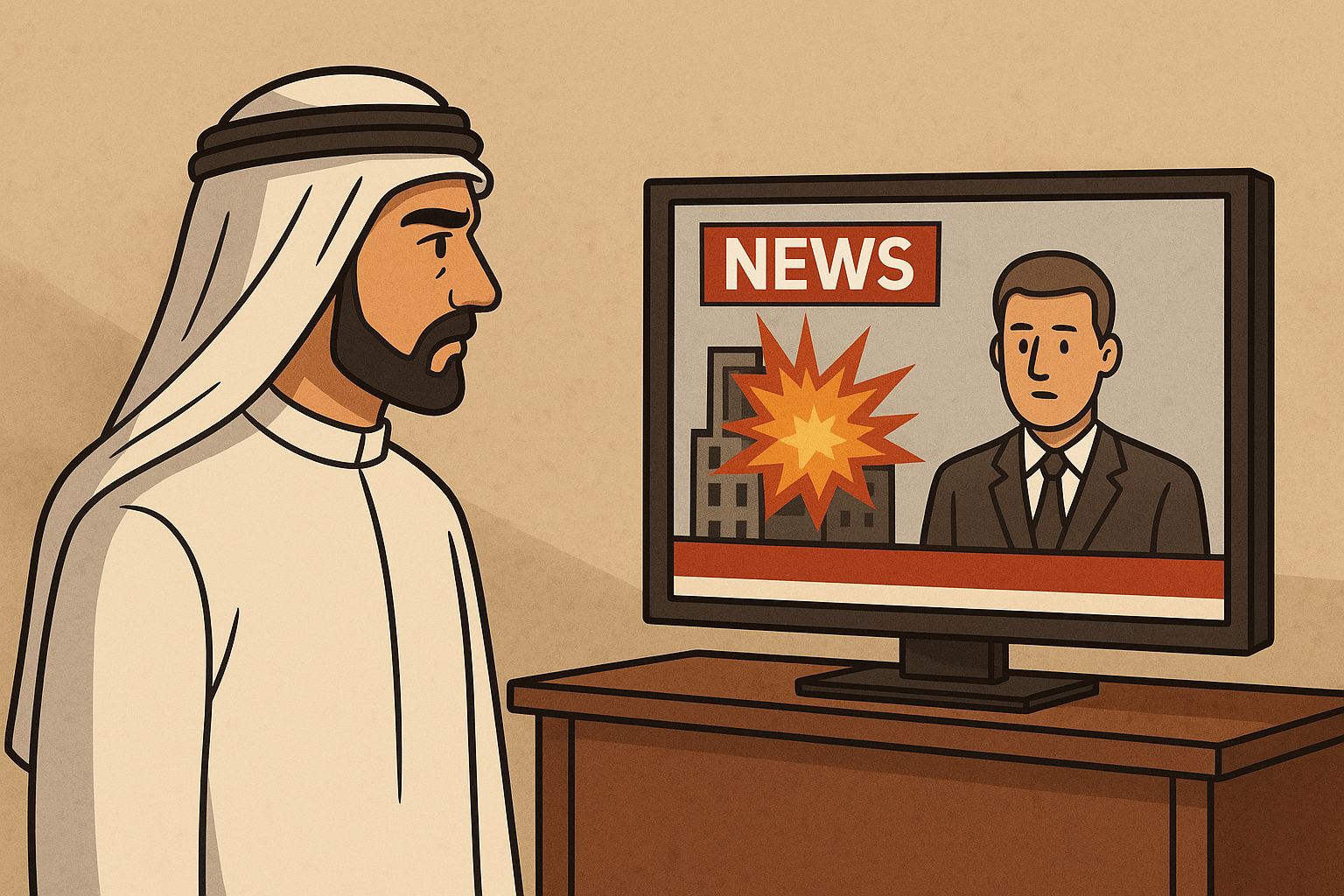
As Israel reshapes the rules of conflict, Egyptian media faces a dilemma: remain an echo of politics or become a credible voice that secures public trust.
Governments may be able to fine-tune their political messaging with precision, but honest media remains the first line of defense for the state itself. In an age where information flows without limits, no truth can be hidden and no impact diminished. Media alone faces its audience with reality, explaining events rather than denying them, in order to maintain its credibility and the trust of the people.
Here lies the paradox between the fires of reality and the calm of the screens. It is not just a fleeting observation, but rather a test of the future of Egyptian media: will it remain merely an echo of politics, or will it become a partner in shaping a national awareness built on truth?
It cannot be denied that every country has its official media with a political function, and that states in times of crisis often prefer a narrative that calms the street rather than one that inflames it. Yet, the line between reassurance and downplaying is perilously thin. If citizens feel their media is belittling the risks, they will lose trust and turn to alternatives. But if the media presents the full truth—framed within Egypt’s position and choices—it preserves credibility without harming national interests.
We must therefore examine the issue in light of how media shapes public perception and trust.
On a tense evening filled with regional anxieties, while Arab and international outlets declared that a full-scale invasion of Gaza was imminent, another reality emerged: the region awoke to an unprecedented scene. Israel, through its actions, effectively declared that no one was outside the circle of targeting. The moment was monumental. Yet those who followed some Egyptian channels and newspapers felt as though it was no more than a “limited raid” or a “localized strike”—as if the event had not rewritten the rules of the region.
Here lies the contradiction: between a reality racing forward in destruction and fire, and a local media discourse that chooses calm and understatement.
Media Weighing Words with Political Scales
For decades, Egyptian media has approached regional issues with the mindset of “political calculation before journalistic reporting.” Editors may know that an Israeli strike carries messages beyond Qatar, and that it signals—just as Netanyahu bluntly said—that Cairo itself is “not far” from the circle of threat. But publishing this truth in its raw form risks upsetting the state’s delicate balancing act:
-
A formal peace with Israel lasting more than four decades.
-
Strategic economic interests and Gulf investments.
-
A central role in Palestinian mediation.
In other words, any strongly worded media rhetoric could be seen as unwanted escalation, opening political and diplomatic fronts at a highly sensitive time.
Neutral Language, Reassuring Messages
Anyone who followed Egyptian newscasts or newspapers after the strike would notice the absence of strong terms like “aggression” or “destruction,” replaced instead with more neutral words like “raid” or “targeting.” The focus was not on the danger of Israel breaking the barrier of a “mediating Arab state,” but on Foreign Ministry statements calling for “restraint” and “de-escalation.”
This reflects a deliberate strategy: to reassure domestic public opinion that “the situation is under control,” and to emphasize that Cairo still holds the threads of regional mediation.
The Gap Between Street and Screen
At this point, we must pause at an essential question:
Does the Egyptian public accept these softened formulations?
The reality suggests otherwise. Citizens need only open their phones to see images and videos from Arab and international platforms—sources far more diverse than the official press. Egyptians no longer wait for state television or government newspapers to learn what happened in Doha, Yemen, Iran, Gaza—or even in Cairo itself.
Here lies the true crisis: when audiences sense a gap between what they see and what they hear from their national media, trust erodes. Media then becomes nothing more than an “official voice” unfit for understanding reality.
To be clear, every country has official media with political tasks, and during crises, governments may favor a calming discourse over an inflaming one. Yet, in today’s media environment—where with a single swipe citizens access countless sources dominated by undeniable images—the boundary between reassurance and downplaying is dangerously wide.
If citizens feel their media is minimizing threats, they will lose trust and seek alternatives. Thus, national media must present the whole truth, but within a framework that clarifies Egypt’s position and choices, safeguarding national security while preserving credibility.
The Israeli strike in Qatar was not a mere passing operation; it was a signal that the rules of the game had changed, and that the entire region is now within range of fire. Egypt, with its geographic and political weight, is not beyond these calculations.
If the state must act with careful precision, the media must fulfill its professional role: to describe reality without embellishment, to present the picture as it is, and to allow citizens to judge the scale of danger themselves. Otherwise, they will drift toward other outlets—some deliberately seeking to exploit the gap between citizens and their national media, and to sow divisive narratives within Egypt’s internal front.
Only by anchoring credibility in truth can national media protect both its audience’s trust and the country’s unity.