

? From Trump’s Blessing to Blair’s Mission: Is Gaza Being Reengineered to Fit Israel’s Design
A New Chapter in an Old Game

Special File – Arab Telegraph : October 2025
When former British Prime Minister Tony Blair suddenly re-entered the Middle East stage—this time with a mandate to help “reorganize” Gaza—the move was celebrated in some Western circles as a fresh path to peace.
But across the Arab world, the question quickly surfaced: Can a man known as the “butcher of Iraq” truly be the architect of Gaza’s reconstruction?
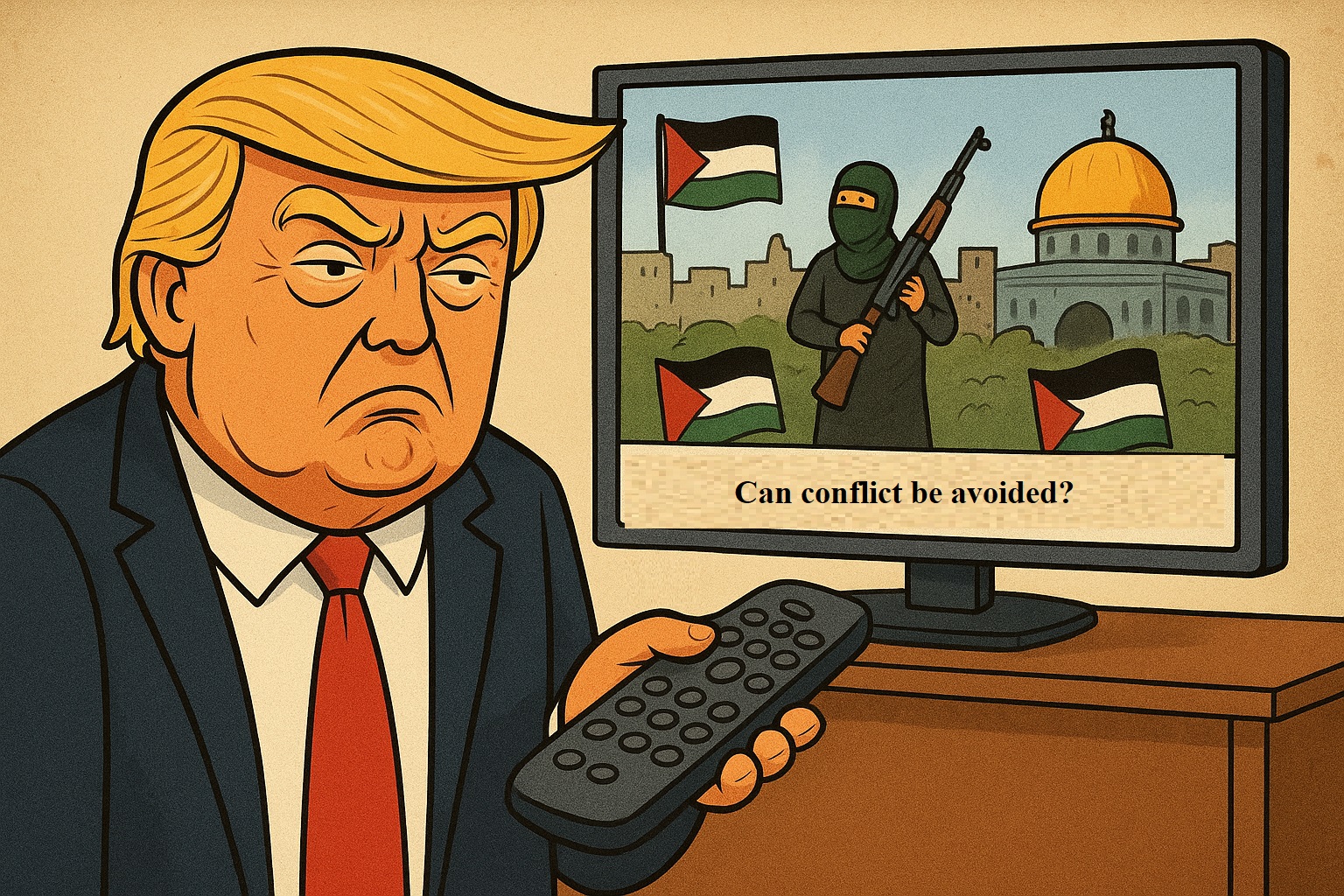
This skepticism grows amid the backdrop of Donald Trump’s visible endorsement of Israel’s strategy—a blessing that seems less about peace and more about shaping the region to Israel’s advantage.
The Illusion of Stability
Blair’s return follows months of military tension and political fragmentation in Gaza. Israel presents the initiative as a “humanitarian framework,” yet its design appears to ensure a controlled Gaza, stripped of resistance and subordinated to security guarantees.
For many Palestinians, the plan feels like the continuation of occupation under a different flag—a “technocratic peace” that empties the struggle of its political essence.
In Arab media, reactions ranged from cautious optimism to outright condemnation. Several analysts described the move as a Western-Israeli attempt to buy time—to freeze the conflict while preparing the next phase of control.
Blair’s Shadow and the Quest ion of Credibility
Blair’s record in Iraq still haunts the region. He himself admitted his decisions were “flawed,” but those words never translated into accountability. His new mission, analysts argue, reflects a selective Western memory—forgiving its own war architects while assigning them to “fix” what others destroyed.
Many Arab commentators therefore see Blair’s appointment not as an act of goodwill, but as a strategic buffer—a way to prevent Palestinian unity from turning into political leverage.
The Arab and Islamic Committees: Parallel or Overridden?
The Arab-Islamic Ministerial Committee—tasked with pursuing a political solution for Gaza—now finds itself overlapped by Blair’s Western-backed mission.
Diplomatic insiders warn that this dual track risks fragmenting the peace process itself.
If Arab initiatives are sidelined, Israel and the United States will once again dominate the agenda under the guise of “international management.”
Internal Palestinian Divisions: The Fault Line Israel Needs
Even before Blair’s arrival, Palestinian divisions were the Achilles’ heel of any national project. Should those rifts resurface—between Gaza’s factions, or between Gaza and the West Bank—Israel will seize the moment.
Past experience shows that fragmentation is the oxygen of Israeli policy; it weakens any coherent negotiation front and justifies further intervention.
Washington, meanwhile, will frame it as “proof” that Palestinians are incapable of self-rule—an argument that perpetuates indefinite external supervision.
Trump’s Endorsement: Strength or Hidden Weakness?
Israel’s signing of the new framework under Trump’s blessing may appear as a show of confidence.
Yet beneath the surface lies deep internal fatigue:
growing casualties, rising costs, and unprecedented dissent within Israeli society.
Some Israeli analysts themselves describe this as a defensive diplomacy—a desperate attempt to regain moral legitimacy after military overreach.
Mapping the Shifts
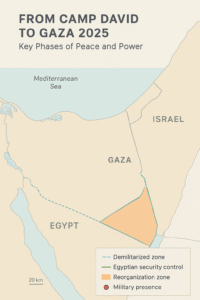
(Infographic reference: “From Camp David to Gaza 2025 — Key Phases of Peace and Power.”)
This accompanying map illustrates:
-
Egypt’s evolving security control in Sinai,
-
the demilitarization corridors,
-
and the proposed “reorganization zones” in Gaza under Blair’s plan.
Together, they reveal how every peace arrangement since 1979 gradually redrew—not just borders—but the balance of sovereignty in the region.
The Core Question
If the Arab states had stood united behind Egypt’s Camp David path, would Israel have respected those borders—or simply expanded the conflict to pursue its old map “from the Nile to the Euphrates”?
The same question echoes today in Gaza:
Is this a peace process—or merely a strategic pause before another war?
Conclusion
Blair’s mission, cloaked in humanitarian language, risks re-engineering Gaza to fit Israel’s security blueprint.
Unless Arab unity and genuine Palestinian sovereignty anchor the process, today’s “stability plan” may become tomorrow’s prelude to chaos.
Roya & Analysis: Ali Khalil
(Arab Telegraph – Special File)
Supporting Sources and References
-
Tony Blair Institute for Global Change, statement on the proposed framework for Gaza’s reconstruction, London, September 2025.
-
United Nations Office for the Coordination of Humanitarian Affairs (OCHA), Gaza Situation Update, August–October 2025.
-
Haaretz and The Guardian, coverage of Israel’s internal military and political divisions following the Gaza conflict, July–September 2025.
-
Brookings Institution – Middle East Policy Brief, “Post-Conflict Administration Models in Gaza,” June 2025.
-
Al Jazeera Investigative Unit, “The Gaza Mandate: How Western Diplomacy Reinvented Control,” special report, October 2025.
-
Tony Blair’s 2023 interview with BBC News, where he admitted his Iraq War “misjudgments” but reaffirmed his “commitment to global stability.”
-
Statements from Arab League and Organization of Islamic Cooperation (OIC) regarding the Arab-Islamic Committee’s role in Gaza’s political process, September 2025.